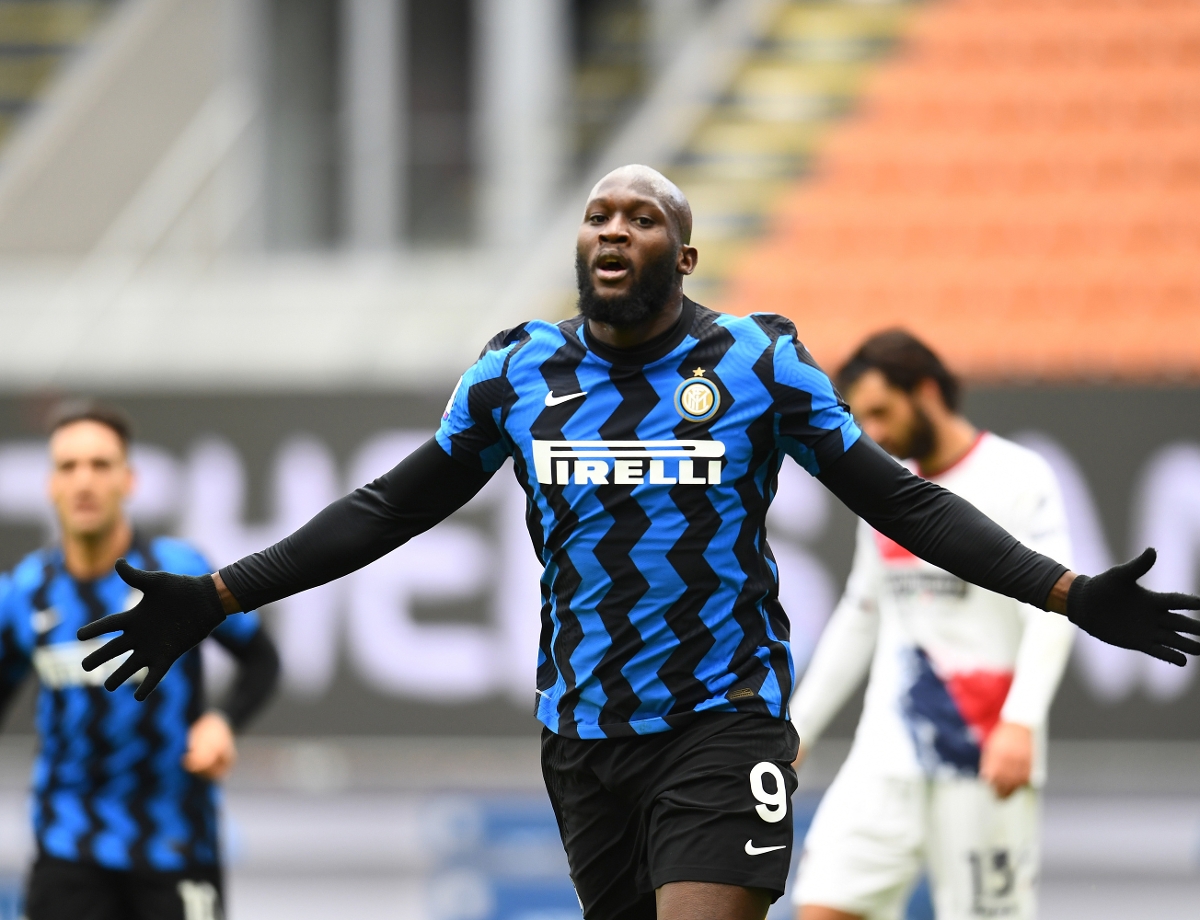
The fourth entry in our series analyzing how star players have been able to raise their game another level this season
The numbers: Lukaku is enjoying the highest goal-scoring return of his career, finding the back of the net 0.87 times per 90 minutes for a title-challenging Inter Milan side. Lukaku is also contributing more than a goal or assist per 90 minutes (1.09), the first time he has done so in his career; Lukaku’s previous highs in these categories were in his age-19 season at West Brom, when he averaged 0.76 goals and 0.99 direct goal contributions per 90.
What’s behind it: Inter are increasingly molding their attack around the talents of Lukaku, who they shattered their transfer record to acquire for $81.40 million dollars in the summer of 2019. Lukaku enjoyed a fine debut season last campaign, finishing as the third-leading scorer in the league with 23 goals as Inter came within one point of the league title. This season, the Belgian striker has increased his already impressive goal contribution while also showcasing more of his all-around game; he is both more involved in possession and more efficient with his use of the ball as a passer and finisher for Antonio Conte’s side.
Playing Style
Lukaku was often used as a target man last year, winning the fourth most aerial duels (83) of any forward in Serie A. This season, he is competing for significantly fewer balls in the air (3.3 per 90, down from 4.7 last season) but getting the ball to feet more with 38.8 touches per 90 (up from 35.6 last season). He is also increasingly involved in progressing the ball forward for Inter, rather than simply holding it up; both his progressive carrying distance per 90 (88.6 yards, up from 49.0 last season) and progressive passing distance per 90 (59.9 yards, up from 47.7) are markedly higher than in 2019-2020.
This shift in Lukaku’s playing style is particularly significant given that his tendency to drop deep was the subject of frequent debate, and often outright criticism, during his time at Manchester United. From Paul Scholes in November 2018: “Because he’s come to Man United, it seems like he thinks he has to be a footballer, he has to come into a number 10 role. He doesn’t. That’s the last thing he needs to do. He’s not got the ability to do that. His strengths are running in behind [and] getting on the end of crosses… He’s someone who has to run behind and he can finish, he can score goals.”
Lukaku certainly looks like a target man, at 6’3″ and over 200 pounds, and the role suited him early in his career when playing for low-possession sides at West Brom at Everton. However, the popular conceptions around Lukaku probably underrate his technical ability while overrating how good he is in the air.
For all the talk of his “heavy first touch,” Lukaku miscontrolled the ball 6.4% of the time as a percentage of his overall live touches in his last season at Manchester United (2018-2019) – not a particularly high rate when you compare it to other forwards at top sides that season, such as Harry Kane (9.3%), Marcus Rashford (6.9%), Mohamed Salah (6.8%), Pierre-Emerick Aubameyang (6.5%), and Sergio Aguero (6.1%).
As an aerial threat, meanwhile, Lukaku is good but not great. His aerial duel success rate has typically hovered between 50% and 55% (with a notable dip down to 37.8% so far this season) and he has scored more goals with his weaker right foot (20) than with his head (15) over the past five seasons.
This is all to say that it makes sense for Lukaku to be playing the more expansive role he currently has at Inter than for him to be pigeonholed as a target man. His responsibilities at Inter are a better match for his natural tendencies than at his previous clubs, and both player and club are thriving.
Finishing
Lukaku is showing that he can be more involved in possession while also getting into the right positions to finish off chances. He’s not just getting more touches in deeper areas, he’s also getting more touches in the box (8.1 per 90, up from 6.9 last season). Additionally, the average distance on his shots has decreased from 13.9 yards last season to 12.7 this campaign.
Lukaku’s heatmaps show that he is seeing a lot more of the ball this season in the inside-right channel and in the “second six-yard box” between the six-yard box and the penalty spot.
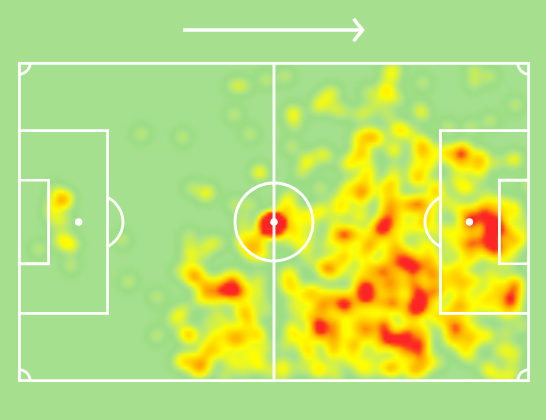
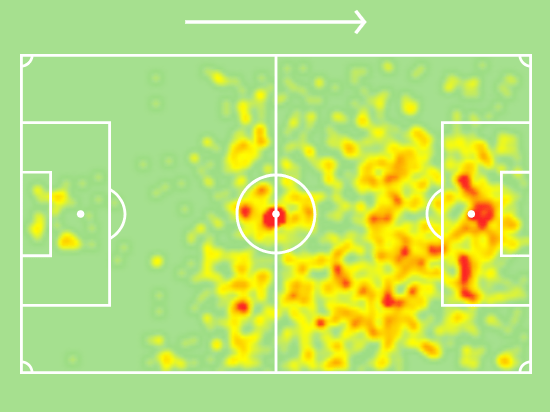
This “second six-yard box” has been a goldmine for Lukaku this season; per Understat, every single one of his open-play goals in the league has come from a central position between four and twelve yards from goal.
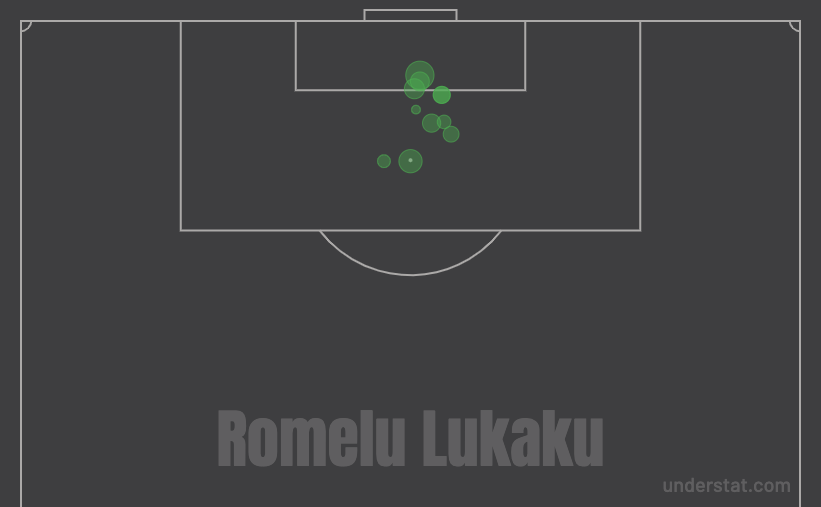
Compared to last season, Lukaku is taking more shots (3.19 per 90, up from 2.87) and with slightly greater accuracy (45.5%, up from 43.2%). The biggest change to his shooting statistics this season is in the quality of his chances; excluding penalties, Lukaku is averaging 0.24 xG/shot – a 50% increase from last season (0.16) and the second-highest figure in Serie A.
This goes to show that the choice between dropping deep and being a productive goal-scorer was always a false dichotomy, as Lukaku has the ability to both start and finish moves. His link-up play also makes it harder for defenders to track him, as we can see in this goal during Inter’s opening day win against Fiorentina.
The move progresses when Lukaku shows for a ball to feet at the edge of the Fiorentina box and receives a line-breaking pass from Arturo Vidal. This is a very typical pattern for Conte’s Inter, who frequently look to advance the ball by getting it to either Lukaku or Martinez for a quick lay-off.
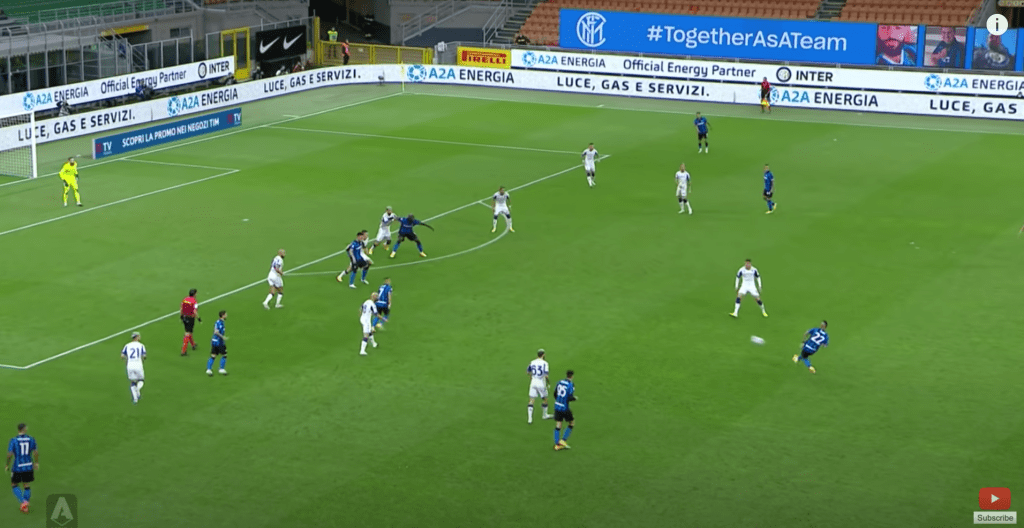
A one-touch pass by Lukaku finds Alexis Sanchez with time and space to pick a pass in behind the defence. By the time Sanchez plays the ball for Achraf Hakimi, Lukaku is already instinctively moving goalside of his marker.
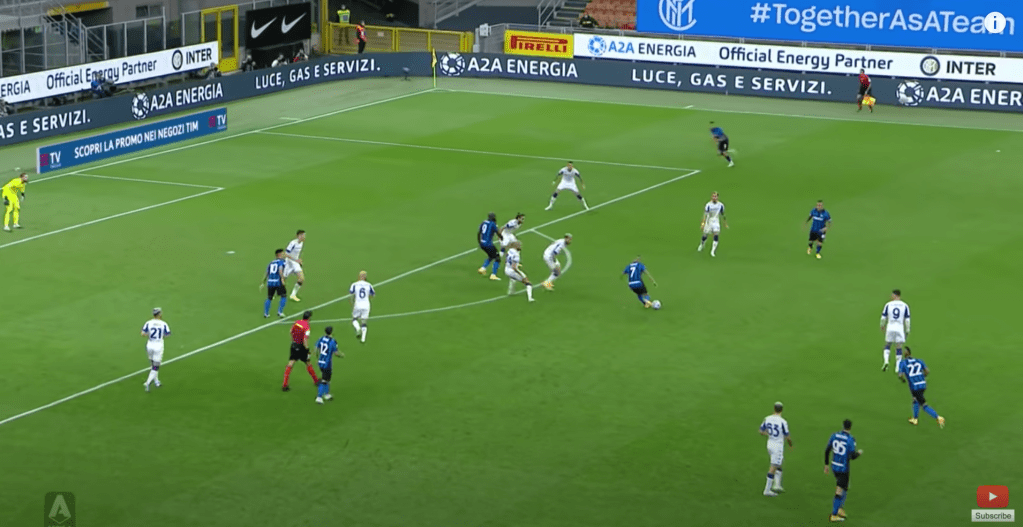
By anticipating how the move would develop after laying the ball off, Lukaku gets himself into the perfect position to convert Hakimi’s cutback as Lukaku is unmarked at the edge of the six yard box.

Creating
Another advantage to Lukaku’s increased involvement is that he is quite an able creator. This would have been more evident last season, when Lukaku ranked 22nd in the league in expected assists, but his teammates were unusually wasteful with the chances he created; his 5.2 expected assists only produced two actual assists, the largest underperformance in the league.
Lukaku’s 3.6 expected assists so far this season rank first among Inter players and 10th in Serie A, and his teammates have converted those chances into three goals.
Less directly, Lukaku’s positioning in the channel and ability to occupy defenders creates valuable space for his teammates – most notably Hakimi. The right wing-back is enjoying a highly prolific debut season for Inter, with six goals and three assists, and is linking well with Lukaku down the side’s right attacking flank.
A good example of the space that Lukaku’s movement creates for Hakimi came in Hakimi’s second goal against Bologna last month, a well-executed counter-attack that sealed Inter’s 3-1 home victory.
Here, Vidal has played a wide ball to Hakimi down the right. Lukaku races up the left channel, dragging Bologna’s left-sided center-back, Takehiro Tomiyasu, away from the ball.
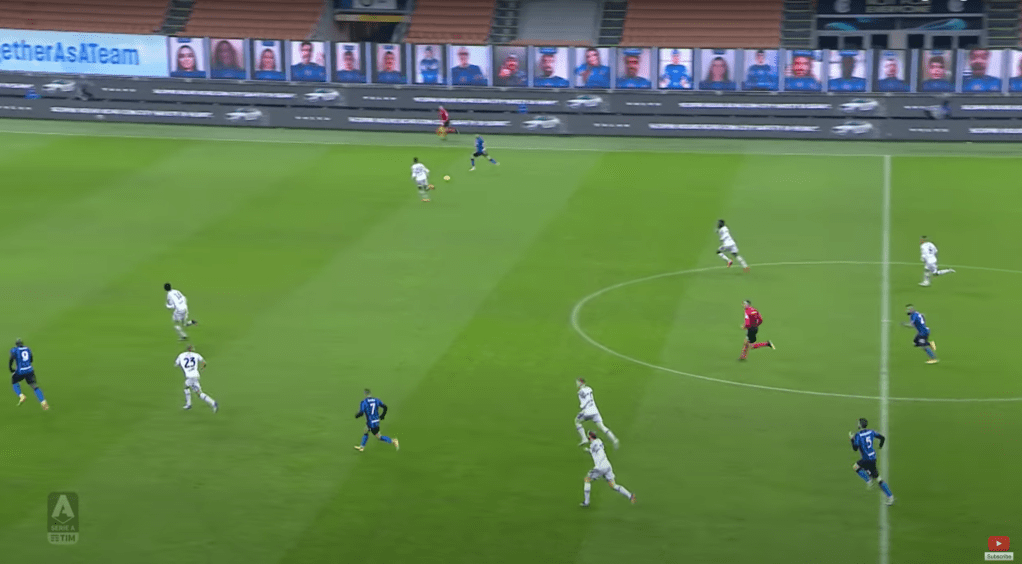
Isolated against his marker, Hakimi easily cuts inside. At this point, Lukaku shifts over to the right and continues to occupy Tomiyasu while creating a lane for Hakimi to continue his run inside. Lukaku’s positioning prevents Tomiyasu from stepping out to challenge Hakimi’s shot, and the wing-back finishes well from just outside the box.
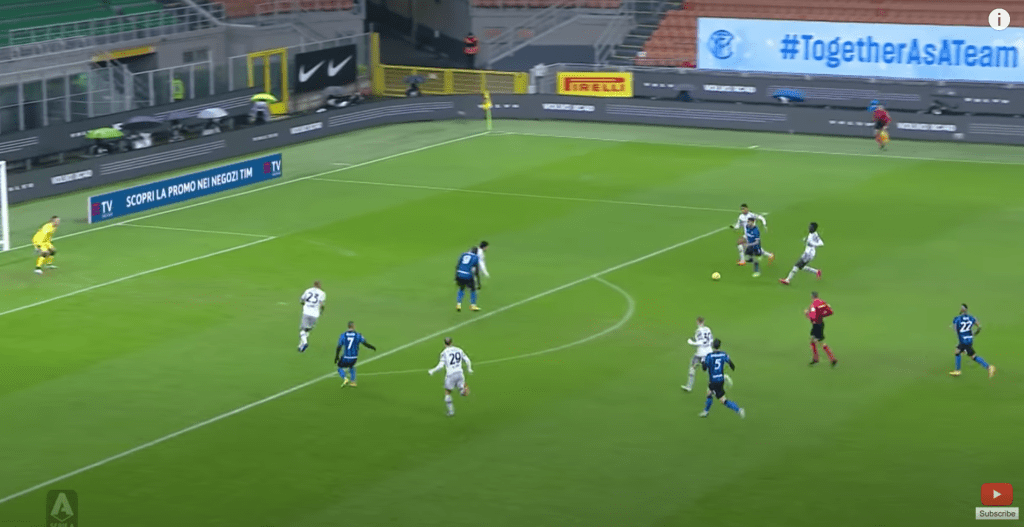
Lukaku is also developing a better understanding with strike partner Lautaro Martinez. The two only assisted each other once last campaign but have already done so three times this season, including this impressive assist by Lukaku during Inter’s 6-2 demolition of Crotone earlier this month.
Lukaku and Martinez will often take turns dropping deep, as they both have the ability to either hold up the ball or run in behind. In this situation, Lukaku provides a vertical passing option for Alessandro Bastoni. It’s a loose pass, with Bastoni forced to release it under pressure, but Lukaku does well to hold off his man and collect it.
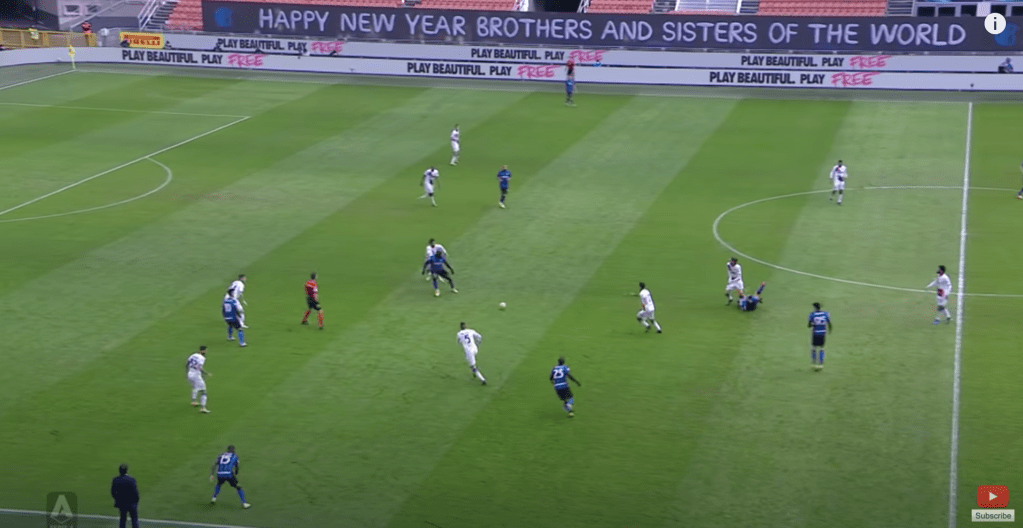
Lukaku shields the ball onto his left foot while Martinez, one on one against his marker, begins a run off the defender’s shoulder.
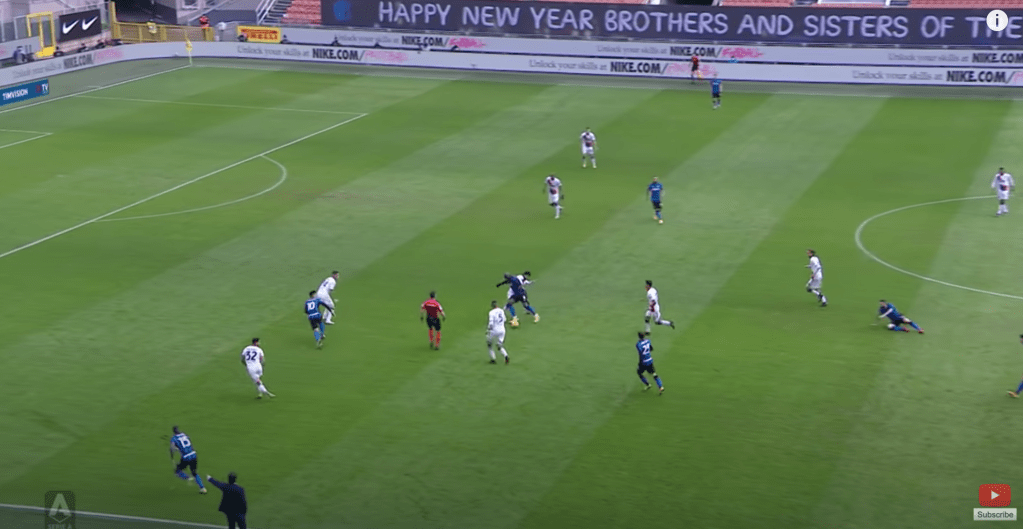
Lukaku places his pass inside, guiding Martinez into a position where the Argentine can collect it goalside of the last defender, and the ball is perfectly weighted for Martinez to run onto it in stride and beat the goalkeeper one-on-one.
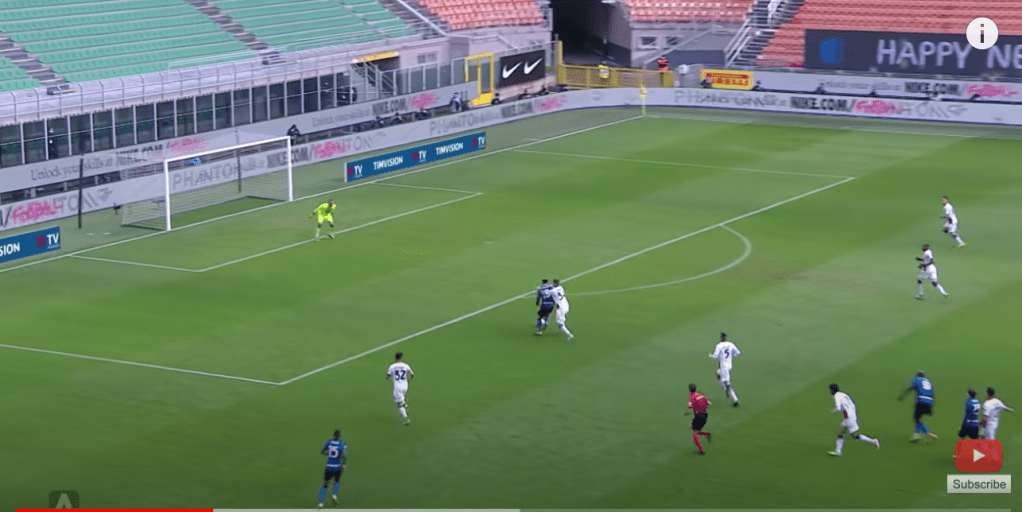
This sequence shows the value of getting Lukaku more involved in possesssion, as there just aren’t many players with the combination of strength, technique, and vision to pull that assist off.
Lukaku is registering the highest pass completion percentage of his career (74.8%), which is probably due both to Lukaku’s increased comfort in Conte’s system and improved sharpness on the ball. It’s quite remarkable, given that he has been playing senior football for over a decade, but Lukaku is still only 27 and continuing to develop in the finer points of the game.
Conclusion
It’s very common for players to improve in their second season at a club, as they are better adjusted to their surroundings and more in tune with their side’s tactics and teammates’ tendencies. This is especially true for players moving to leagues in different countries, as Lukaku did when he joined Inter after seven seasons in the Premier League.
In Lukaku’s case, he is finding success because both player and club are adapting to each other. In Conte, Lukaku has a manager who prizes his particular skillset and whose tactics allow the player’s overall game to flourish. Conte has spoken of wanting to sign Lukaku for years, as he targeted the Belgian striker while managing Juventus and Chelsea, and Lukaku in turn has credited Conte with taking his game to “another level.”
You’d have to go back to 2009-2010, Lukaku’s last season at Anderlecht and Jose Mourinho’s final season at Inter, to find the last time that either club or player won a league title. With the striker in this devastating form and Inter currently three points off the top, those droughts could be ending very soon.
 The Counterpress