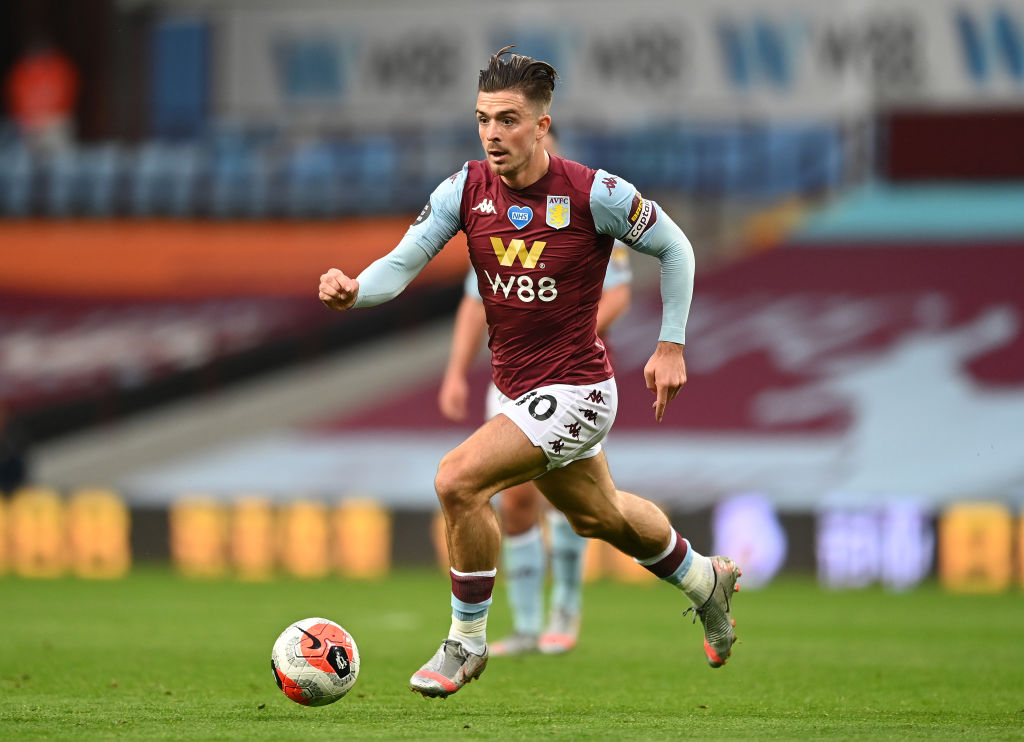
The fifth entry in our series analyzing how star players have been able to raise their game another level this season
The numbers: Grealish has long had more substance to his game than he was given credit for, and he was an excellent ball progressor, dribbler, and chance creator for a struggling Aston Villa side last season. This campaign, Grealish has added more end product to his game with a combined 13 direct goal contributions (five goals and eight assists) in 17 matches – just one fewer than he had all of last season (eight goals and six assists).
What’s behind it: Grealish is playing in a more advanced role than last season for a much higher-functioning Aston Villa side. As a newly promoted club last year, Villa were a low-possession (43.9% on average) and low-scoring side (1.05 goals per match). This season, they are seeing 49.2% of the ball on average and have one of the most potent attacks in the league (1.76 goals per match) after improving their forward line in the summer.
Grealish is still primarily a left winger on Villa’s team sheet, but their switch from a mostly 4-3-3 shape to a 4-2-3-1 shape this season has helped him increase his output by moving him further upfield and creating a natural “number ten” role behind new striker Ollie Watkins. By operating closer to the opposition goal, Grealish has been able to increase the efficiency of the shots that he both takes and creates. Grealish’s improved teammates are also doing a better job of converting the chances that he provides. Therefore, while Grealish’s style of play hasn’t changed significantly – he remains a very high-volume ball carrier, creator, and shooter with elite dribbling and shot-creation ability – his output has increased across the board.
Playing Style
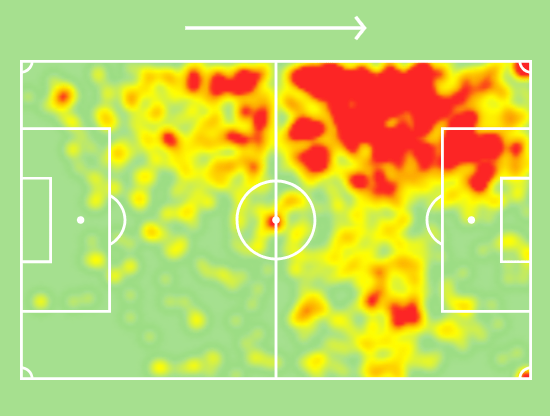
Grealish is playing further up the pitch this season, as we can see both in his heat maps (courtesy of SofaScore) and positional data from Smarterscout. Grealish’s touches were all over the place last season, as Villa were often penned into their own half and he had to drop into very deep positions to give his side a chance to progress the ball.
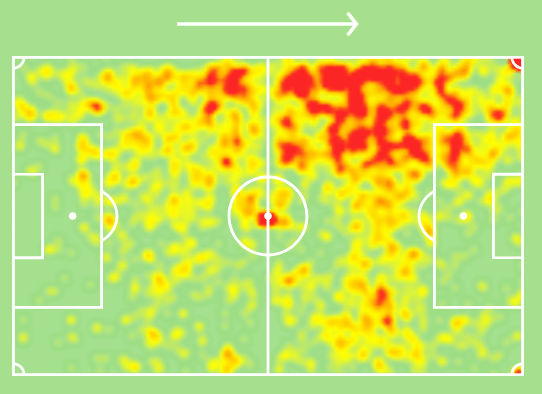
This season, Grealish’s touches are much more concentrated in the final third of the pitch. The majority of his touches (52.1%) have come in the attacking third, up from 45.4% last season, and the percentage of his touches in his own defensive third has declined from 14.7% to 9.5%.
Grealish is a difficult player to label, given the freedom he is afforded at Villa; he is certainly more of a left-sided player but has considerable license to either tuck in centrally or switch flanks. There was a time when nearly every top club in England boasted a “left-sided number 10” – a role that Eden Hazard, Philippe Coutinho, Christian Eriksen, and David Silva helped to popularize – and Grealish is probably the best example of that lineage in today’s Premier League.
Smarterscout classifies Grealish as a left winger for the plurality of his league minutes this season (701), with additional time spent as a central attacking midfielder (458). Grealish typically blends the two positions by operating in the left half-space, whether he takes up a wing role on the team sheet to the left of Ross Barkley or a central role with Anwar El-Ghazi to his left. One notable change in the Smarterscout data is that Grealish’s minutes logged as a “central midfielder” have declined sharply, from 695 last season to just 22 this season.
Grealish has previously indicated that his preferred position is as a “number 8” in central midfield, but manager Dean Smith’s decision to change Villa’s primary formation from 4-3-3 to 4-2-3-1 has eliminated a central midfield role and accordingly shifted Grealish further up the pitch.
Even with this change to his position, Grealish continues to be integral in Villa’s build-up play and he remains one of Europe’s elite ball carriers. Grealish’s progressive carrying distance (4,176 yards) and carries into the final third (66) easily lead all midfielders and forwards in the Premier League, as Villa rely on him to break the lines and initiate attacking moves.
Premier League defenders still have not figured out how to neutralize Grealish’s dribbling ability – except, of course, to foul him. His 49 successful take-ons are the third-highest in the league and he is both attempting more dribbles per 90 minutes (4.1, up from 3.4) and succeeding with them at a higher rate (71.0%, up from 59.2%).
Defensively, Grealish is less active than last season. Part of this may be due to him tracking back less, but it’s also part of an overall trend in the Premier League of clubs doing far less pressing in a grueling and congested season. Villa’s ball pressures per match have declined by 19.6% this season (from 153.6 last season to 123.4 this campaign), while Grealish’s have declined by 15.6% (from 16.0 to 13.5).
The more notable change in Grealish’s defensive actions has come in the areas where he is applying pressure. Nearly two-fifths of his defensive pressures are coming in the attacking third (38.4%), a significant increase from 31.5% last season, and the percentage coming in his own defensive third has dropped from 28.4% to 23.1%.
Villa are a more solid defensive side this season, with their 1.06 goals against per match the sixth-best mark in the league and a major improvement from the 1.74 they conceded on average last season. With their improved resilience behind the ball, it is sensible that they are affording Grealish more freedom to stay forward when out of possession.
Creating
Grealish was already a very effective chance creator, finishing second to Kevin de Bruyne in key passes among Premier League players last year. This season, Grealish is producing on another level as he has increased his key passes per 90 from 2.6 to 3.6. The chances that he’s creating are also of a higher quality, with an xA of 0.13 per key pass this season (up from 0.09 in 2019-2020).
In his more advanced role, Grealish is able to consistently get on the ball more in dangerous areas: his 139 touches in the penalty box rank third in the league and already match his figure from last season. This is helping him create more (and more dangerous) shooting opportunities for his teammates, as defenses aren’t as settled to deal with his deliveries and have less time to react to them.
One of the real anomalies in Grealish’s numbers is how frequently he dribbles the ball into the box. His 59 carries into the penalty area nearly match his total from last season (63) and are almost 50% higher than anyone else in Europe’s top five leagues (Hirving Lozano, at Napoli, is second with 41).
This statistic also speaks to the value of having Grealish further up the pitch. Whereas Villa used to rely on Grealish just to get the ball into the attacking third, his ball progression is now getting them close to the goal where they can create good shooting opportunities. Compared to last season, his carries into the final third per 90 minutes have increased slightly (3.9, up from 3.6) while his carries into the penalty area per 90 minutes have nearly doubled (3.5, up from 1.8).
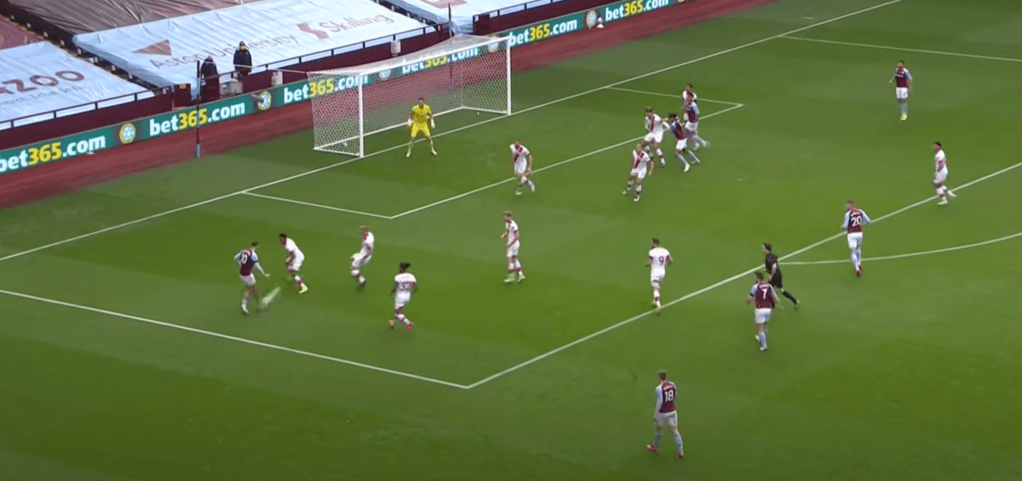
Grealish will often look for space high and wide from which he can dribble into the edge of the box; once there, and with defenders wary of getting too tight to him, he’ll use the space to pick his pass either toward the six-yard box or to an oncoming runner. You can see the very similar areas from which he assisted teammates in matches this season against Southampton, Arsenal, Manchester United, and Newcastle below.
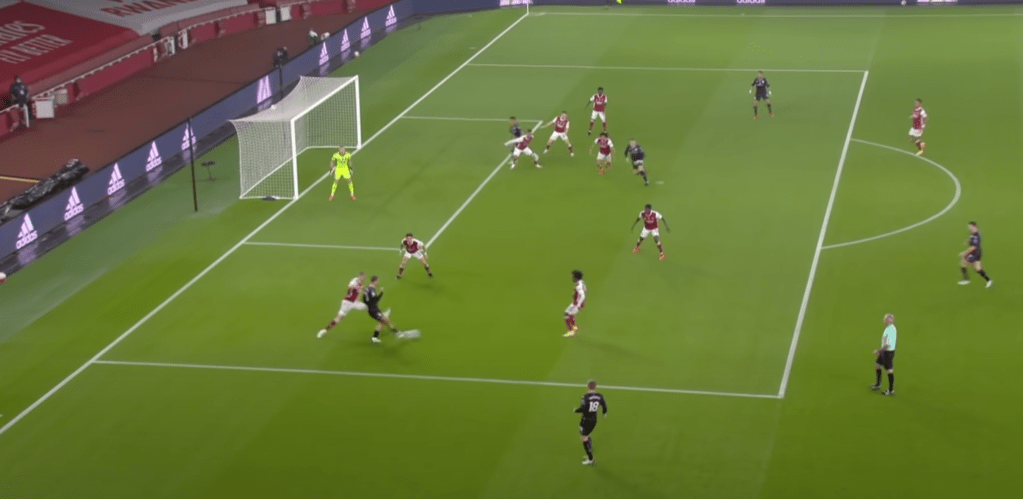
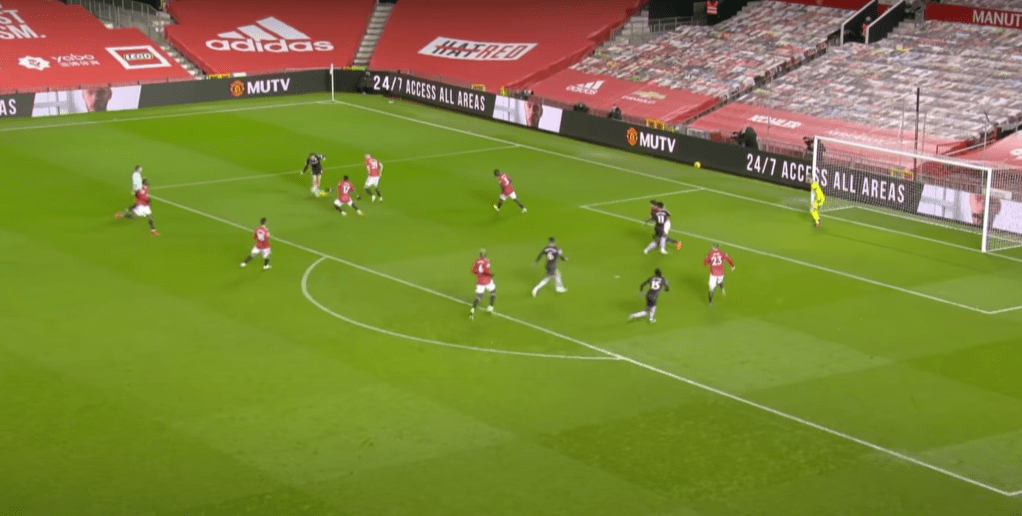
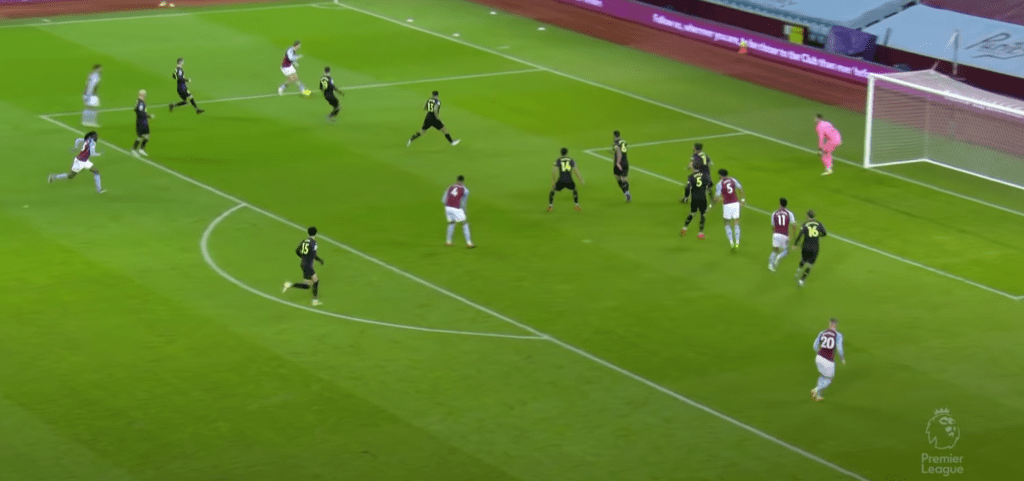
Per Understat data, the percentage of Grealish’s key passes that originate in the box has increased from 61% last campaign to 68% this season. This is where Grealish is fashioning the highest-quality chances, as his expected assists per key pass rises from 0.03 on passes from outside the box to 0.17 on passes inside the area, and six of his eight league assists so far this season have come from inside the box.
Grealish’s teammates are also doing a better job of finishing the opportunities he lays on this season; his 7.0 expected assists last season yielded six goals, while his 6.9 expected assists thus far have already led to eight goals. The club invested heavily in their forward line last summer, bringing in striker Ollie Watkins for $33.88m and right winger Bertrand Traoré for $20.24m, and Grealish is combining well with both of them: he has assisted three of Traoré’s four league goals and three of Watkins’ six goals from open play.
Finishing
Grealish is probably never going to be a particularly efficient finisher, as his shot maps show he generally makes a lot of speculative efforts and rarely gets opportunities inside the six-yard box. On these shot maps for the last two seasons, also from Understat, larger circles represent higher xG, green denotes goals, purple denotes saved shots, red denotes shots off target, and yellow denotes shots that hit the frame of the goal.
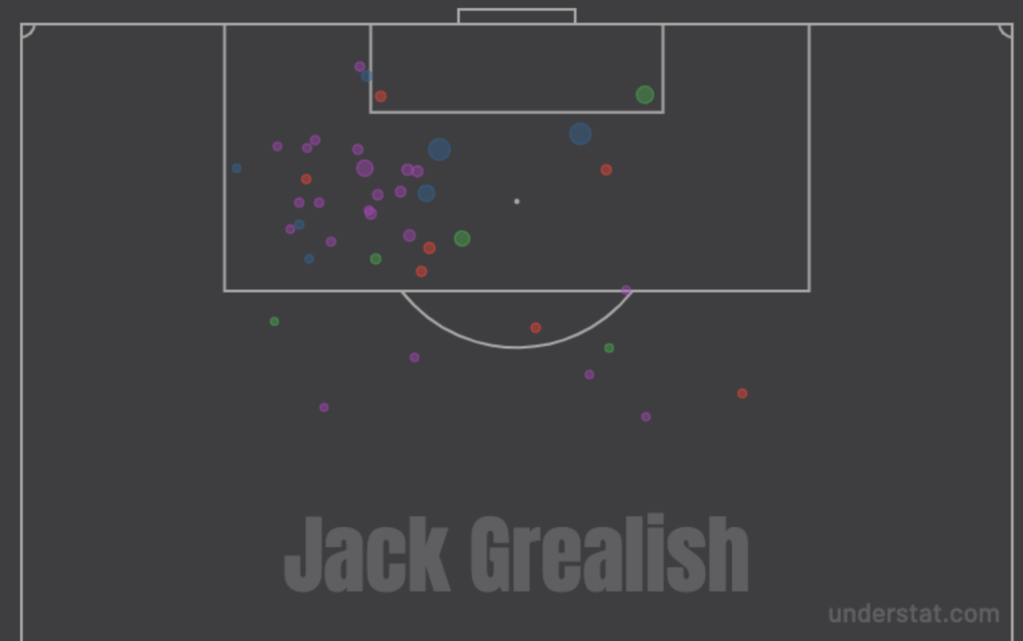
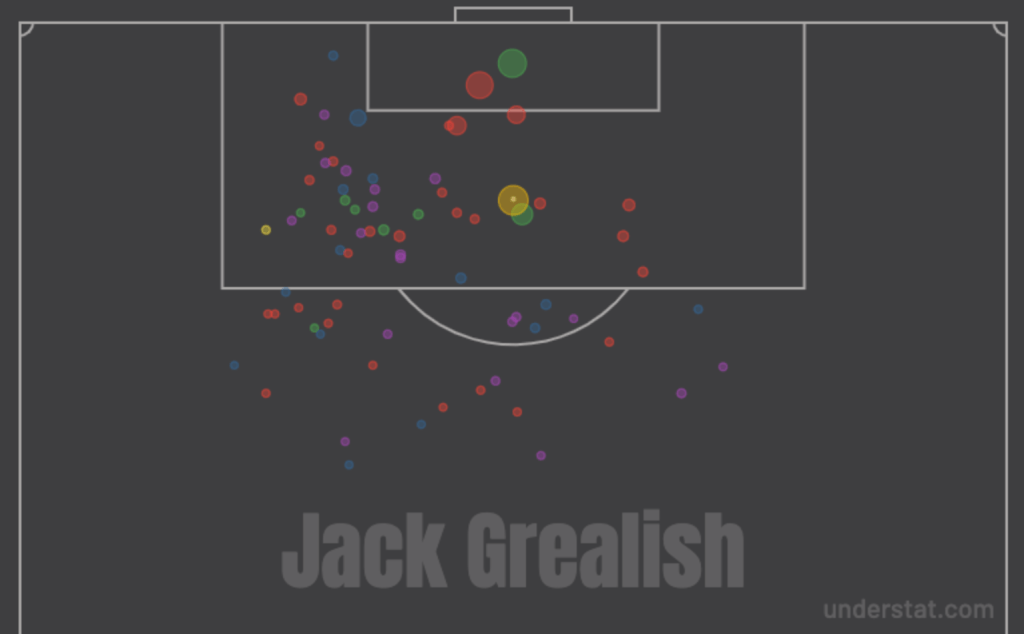
These shot patterns make sense given his role in the side as Villa’s chief ball progressor and creator; because he spends so much time on the ball or making himself available as a short option, he doesn’t make many off-the-ball runs into the box.
Still, Grealish has been able to increase his shooting efficiency slightly this season by cutting down on long-range efforts. Over three-quarters of his shots this season (78.0%) have come from inside the box, a marked increase from 60.3% last season, and he has accordingly been able to raise his shooting volume (2.36 shots/90, up from 2.00 last season) without sacrificing accuracy (30.0% on target this season, virtually unchanged from 30.6% last season.)
He’s still able to score the occasional worldie, but it’s not as tempting for him to wind up from outside the box now that he has more attacking weapons in the side and Villa have become better at retaining and recycling possession.
Conclusion
Grealish’s impressive numbers last season, particularly in terms of chance creation, sparked a great deal of speculation about how well he could perform in a top Premier League side. We are essentially seeing the answer to that question now in Grealish’s age-25 season; he just didn’t have to move to a more illustrious club for it to happen, as the side around him has improved.
Grealish remains a very high-volume player in just about everything he does – from touches to carries to chances created and shots – and he has been able to increase his efficiency in nearly every attacking category this season by initiating these actions closer to the goal.
There is no better player in the Premier League when it comes to moving the ball forward, and now the yards that Grealish is gaining for his side are becoming more decisive; his progressive carries aren’t just helping Villa get the ball into the final third, they’re increasingly helping Villa get the ball into the box.
In short, Grealish is getting more touches in areas where his ball progressing ability can create the difference between low-quality chances and high-quality ones. That change, combined with having more capable finishers around him to convert his chances, has helped to make Villa one of the most potent attacking sides in the league.
 The Counterpress